
Written by Kate Pechacek
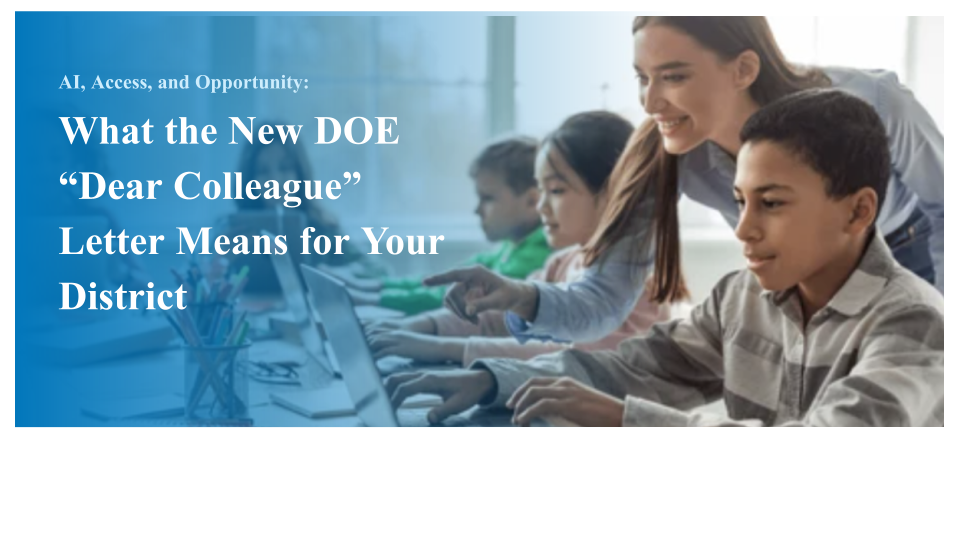
With so many things happening at the government and policy level affecting schools, you may have missed some good news that dropped this week. On July 22nd, the U.S. Department of Education released a landmark “Dear Colleague” letter. If you’re leading a district in 2025, it’s worth a close read. For the first time, the DOE has officially given the green light to use federal grant funds, both formula and discretionary, to support artificial intelligence tools that improve student learning outcomes. And that opens a new door for innovation in your schools.
But the DOE isn’t just handing out a blank check for any AI-driven product that promises big results. Instead, they’ve laid out a focused, thoughtful roadmap for how AI can, and should, be used in K–12 education. Here’s what you need to know.
 What the DOE AI guidance actually says
The July 22 guidance outlines three approved categories where AI tools may be funded:
- AI-based instructional materials: These include adaptive platforms, personalized learning supports, and tools that adjust in real time to student needs.
- AI-enhanced tutoring systems: Think hybrid human-AI models, scheduling platforms, or intelligent tutors that supplement classroom instruction.
- AI for college and career advising: This covers tools that help students explore pathways, navigate financial aid, or identify risks early.
The DOE also emphasized the principles of responsible AI use, which include:
- Being educator-led
- Upholding ethics and accessibility
- Ensuring transparency and student privacy
- Involving community and stakeholder input
According to the guidance provided, the attempt has been made to highlight that this really isn’t just about using AI. It is about using AI well; in a way that truly supports great teaching and learning. As a nearly 30 year educator and someone dedicated to supporting systems-improving K12 solutions, I want you to have good information about how to choose solutions that not only meet the guidelines but will support the priorities you have for your students.
Best practices for choosing AI tools
As district leaders, here are some “filter” questions to ask yourself and your leadership team when considering new tools under this guidance:
- Does the tool solve a real instructional or communication challenge in my district?
- Is the tool accessible for all learners—including multilingual students, students with disabilities, and those with limited tech access?
- Can I trust the company’s data and privacy practices to protect student information?
- Does the tool enhance human connection rather than replace it?
To my point about alignment with your school district’s priorities for your students: Can we measure its impact on learning, belonging, and opportunity?
The best AI tools are much like books, don’t judge by the cover or who has the best, most engaging marketing or “flashiness”. Stick to the questions above to ensure the tools are effective and inclusive. Choosing tools that are teacher-empowering is also essential. In my years in education, it became very clear that “what’s best for kids” includes engaged and empowered teachers.
How does TranslateLive stack up?
TranslateLive’s Instant Language Assistant (ILA) is a strong fit for Category 1: AI-based instructional materials under the new DOE guidance. It enables real-time translation and captioning in 200+ languages and dialects (including ASL) making instruction more accessible for multilingual learners.
More than just translation, ILA supports home language instruction for newcomers, which is critical for academic comprehension and language development. This kind of skill development is also foundational in supporting key ESSA outcomes like reading by grade 3 and on-time graduation. And because it works in real time, it keeps students and teachers in the flow of instruction rather than on the outside looking in.
Most importantly, ILA keeps human connection at the center, empowering educators and students to build relationships, not just exchange information.
Seize this moment
This new federal guidance isn’t just about funding. It’s about reimagining what a modern school district looks like. It’s about innovative technology used to create a powerful launchpad for K12 students.
TranslateLive is here to support your students in the classroom, and the solutions also extends from the classroom, to the boardroom and in-between as a translation bridge for families and the larger school community. Please reach out if you are interested in learning more.
Together, let’s open every door, in every language.
About TranslateLive
TranslateLive was founded on a powerful idea: Everyone deserves to be heard. It is revolutionizing the way people connect across languages and cultures. As a leading language translation platform, TranslateLive empowers individuals, businesses, school districts, and organizations to communicate effectively in real time. The innovative solutions provide unmatched accuracy, speed, and security, ensuring users can rely on the technology for their most critical communication needs. By prioritizing accessibility and ease of use, TranslateLive is not just transforming conversations—it’s building bridges worldwide. Join us to make every voice understood.
Reach out to learn more. https://www.translatelive.com/contact-us/
| Kate Pechacek, M.Ed.
TranslateLive K12 Strategic Advisor
|
Kate began her nearly thirty-year career in education as a secondary math teacher. Beginning with over a decade as a classroom teacher she then held multiple site and district leadership roles in curriculum, instruction, assessment, and MTSS within rural, suburban, and urban settings.
She then spent ten years in education technology first supporting hundreds of different K12 school districts as a partner success manager, trainer, and solutions engineer; and then leading Customer Success, Sales, Marketing, and Research teams. She has since applied her experience as the CEO and founder of OpendoorsEd, consulting with systems-improving ed tech organizations to ensure positive impact on K12 school systems. |


